How to See Art
Jul 2026
On a recent trip to NYC, I found myself standing in front of yet another painting at the Guggenheim. All the paintings I had seen over the last few days had started to meld together in my brain. My brain was saturated, perhaps a bit bored, and I was struggling to identify what made this one special. With scarcely anything better to do, I started to verbalize, in my head, what I was looking at, bit by bit. It was then that I realized that I had been looking at art all wrong my entire life.
You see, I know little about art. But I enjoy seeing paintings in person and have seen my fair share over the years. The way I used to look at art was, well, to do just that: look. As you might look at a piece of bread or gravel on the road as you go about your day. This "technique" does get the job done. Perhaps it is even the right way to appreciate some pieces of art where you are to enjoy the gestalt without paying attention to the constituent pieces. But it is not optimal for most art.
What I realized in NYC is that the simple act of verbalizing to yourself, inside your head, what you are looking at can increase your appreciation of a painting multifold. In this essay, I want to give some examples of my CoT (chain of thought) to show how much of a difference verbalizing can make. (The one simple trick to enjoying art that art museums don't want you to know!) I will attempt to recreate my CoT from when I first saw these paintings.
Here is Hopper's Gas:
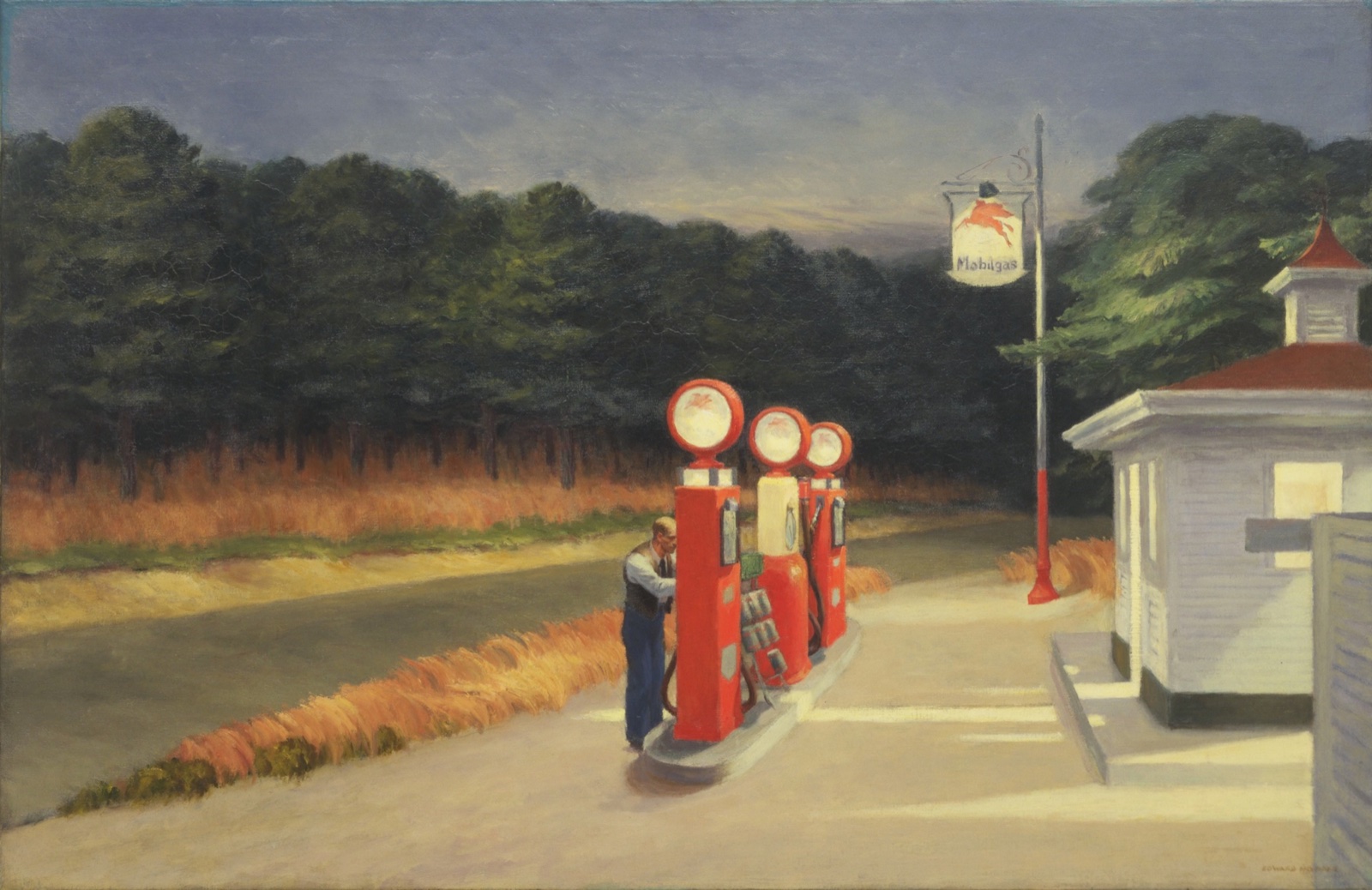
What do you see? Without verbalizing, I do not see much. My reaction would be something like: "Huh, gas station, man, seems cold, maybe dawn or dusk." Now, this reaction is not empty of content, as I said before, I am getting the gestalt of the piece. But there is so much more to see!
Here is my CoT if I were to verbalize: "There is a man at the gas pump. There are three red pumps and the center one is colored white at the top. It is dusk - well it could be dawn also. It feels that the weather is chilly but the man is not wearing a jacket or sweater. There is dense forest on the other side of the road. It's windy, you can tell from the leaves. The trees all sort of meld together. Below the trees there is dense hay-colored foliage. There is the same foliage on the other side of the road also - where the gas station is - suggesting that a similar forest was cut down to build the station. There is a sign pole with a hanging sign with the words Mobilgas. There is a small cabin next to the pumps and the lights inside are on. Is somebody else there? The light from the cabin is spilling outside and cutting through the cabin's shadow. Huh, there is no car, so perhaps the man works at the station and isn't a customer."
That is an order of magnitude more content than what I got the first time. And I am sure I missed details about the art style, strokes of the brush, color composition and whatnot. That can be fixed by learning more about art. But even without that, I got much more out of the painting and it sits better in my memory. I was at this gallery several months ago and still remember this painting.
You might argue that most of these are mundane details. Who cares if the middle pump is slightly different? I don't quite agree. The details are somewhat interesting. But verbalizing is not only for noticing the small details. Many interesting effects are downstream of it.
Let's try another one. Here is one from Münter:
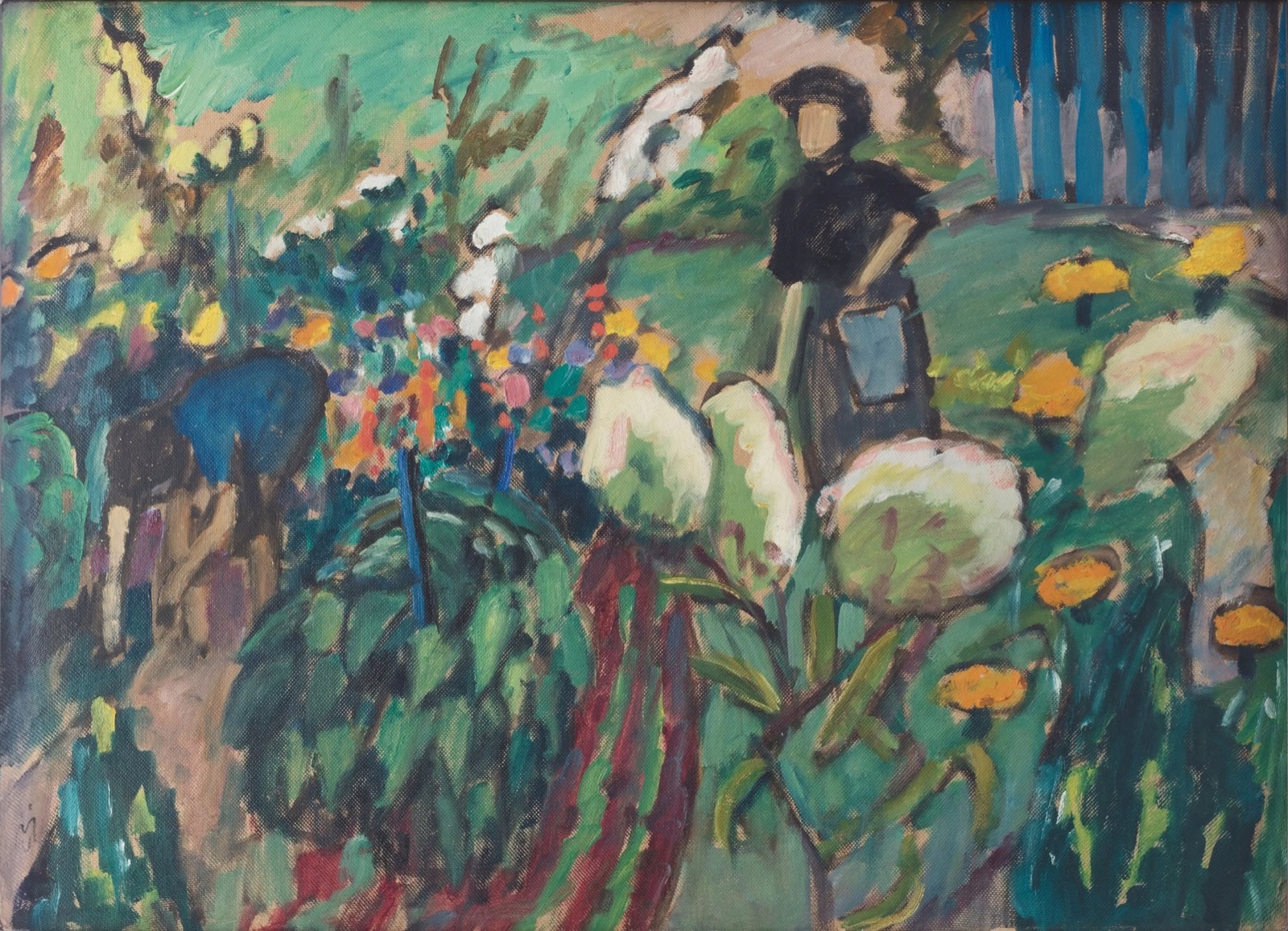
What do you see? All I got from the painting before I verbalized was like: "Garden, uh flowers, a woman, messy strokes."
Here is my CoT: "We are looking at a garden. The colors are muted and the strokes are messy. The flowers in the front are almost as big as the woman which means we are really close to the flowers. There are some yellow ones scattered throughout, some hedges, some long red lines. I don't know what those are. On the left - wait, there's another person! Unclear if man or woman but they are bent at the waist and appear to be tending to the soil. They are surrounded by flowers. On the top right of the painting there are several vertical blue stripes - a fence, maybe? The woman's face is without detail and she is holding a basket or pail. There is a riot of fauna really. Nothing is identifiable."
I like this painting because this was the first time I was genuinely caught by surprise while looking at one. I had completely missed the person on the left at first. Many an art critic talks about this experience but it never felt real to me until I had experienced it.
Münter was an expressionist. Wikipedia says the typical trait of expressionism is "to present the world solely from a subjective perspective, distorting it radically for emotional effect in order to evoke moods or ideas." I could've read this definition before having the CoT and it would be word salad to me. But having truly seen the painting I am able to anchor the words to reality. I suspect Münter is trying to convey the feeling of being lost among the flowers as a child while your mother and sibling (perhaps) work the garden. See? So much to interpret, all enabled by verbalizing.
After you've done this for a few paintings, you start to notice differences and similarities. An entire new axis of appreciation opens up, letting you access something that does not exist in either work but only in how they relate to each other. Let's compare the previous one to this landscape by Kandinsky, Münter's contemporary and romantic partner:
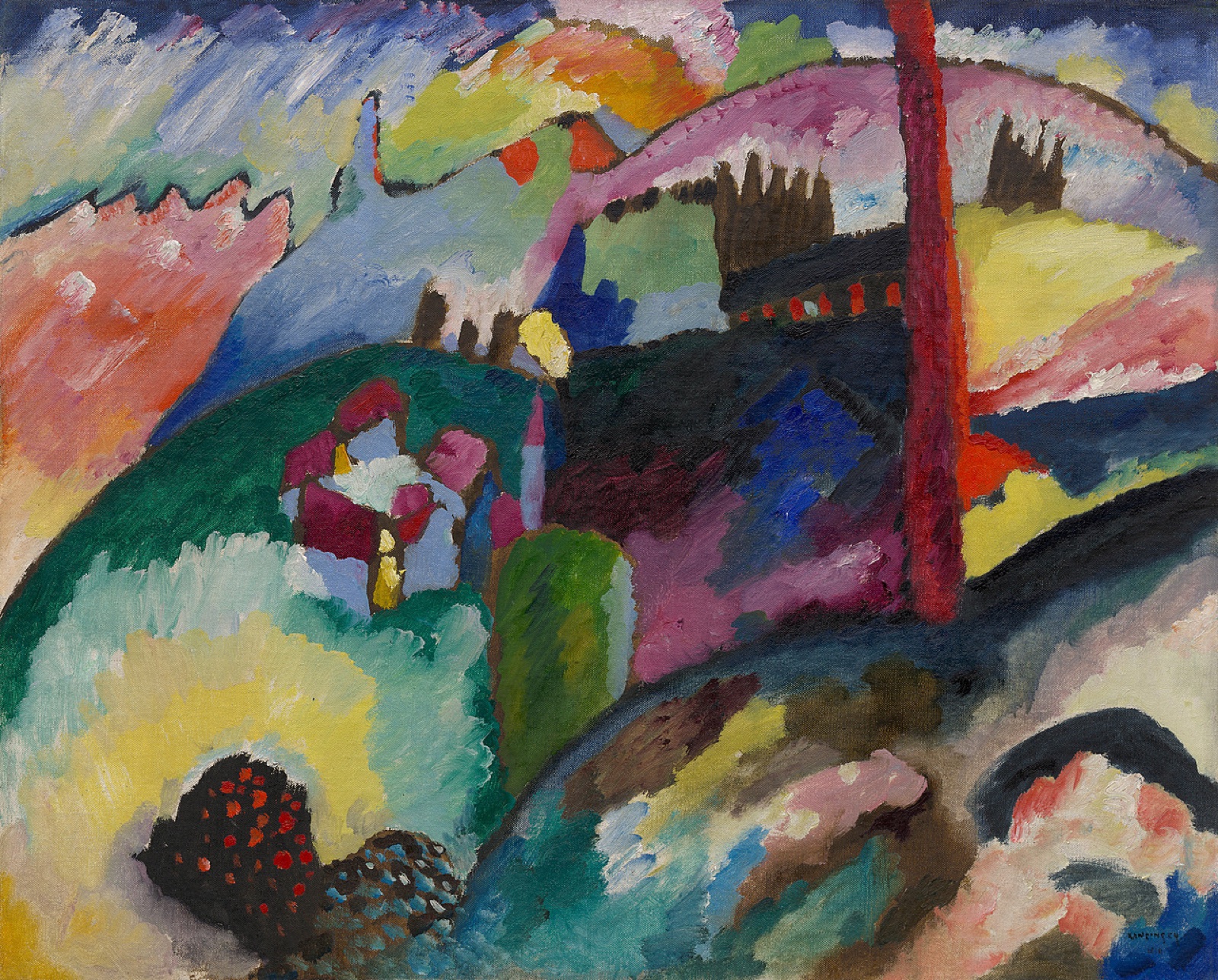
What do you see? Here is my CoT: "The frame is almost square. It is a hilly landscape. The colors are completely unnatural unlike the previous painting. Shades of purple, blues, reds, oranges. There are some black blobs with red and blue dots - are those animals? There appear to be five houses arranged in an irregular pentagon on one of the hills. To its right, a larger house in black with red pillars. There is perhaps another house between them but all I can see is a dark blue slanted rectangle that reminds me of a roof. In the top right, a castle or church in the far distance. There is a red horizontal pillar - I did not seen that until now. At the top, the sun is rising or setting or that could be another hill. Hard to tell. At the bottom, more blobs of color that remind me of dolphins porpoising in water. Or they could be foxes."
It really appears that Münter and Kandinsky are in conversation here. There are clear similarities between the two paintings (e.g., they are both paintings of a natural scene and in the expressionist style) and clear differences (e.g., the color choices). Exactly what you'd expect to find if two people were arguing about something or trying to get at something from different angles. As I said before, art critics often say such things but it is hardly real until you see it for yourself.
Trying to interpret the paintings a bit more, I want to say that Kandinsky is advancing the conversation by saying that the colors need not adhere to reality, they can be whatever conveys the emotion best. What is he trying to convey then with the unnatural colors? Perhaps that the landscape feels foreign to him. This painting, as I later found out, is called Landscape with Chimney Factory, so the red pillar is a chimney. An ugly factory amidst beautiful, rolling hills can easily make the scene feel foreign. However, my interpretation is not fully right as the Münter painting came one year after the Kandinsky one (1911 vs. 1910). So it is Münter advancing the conversation, not Kandinsky. Be that as it may, the point still stands: it was verbalizing that allowed me to generate a falsifiable hypothesis in the first place.
Verbalizing is not only good for paintings. Here is a picture of the Stanford Dish, a radio telescope:
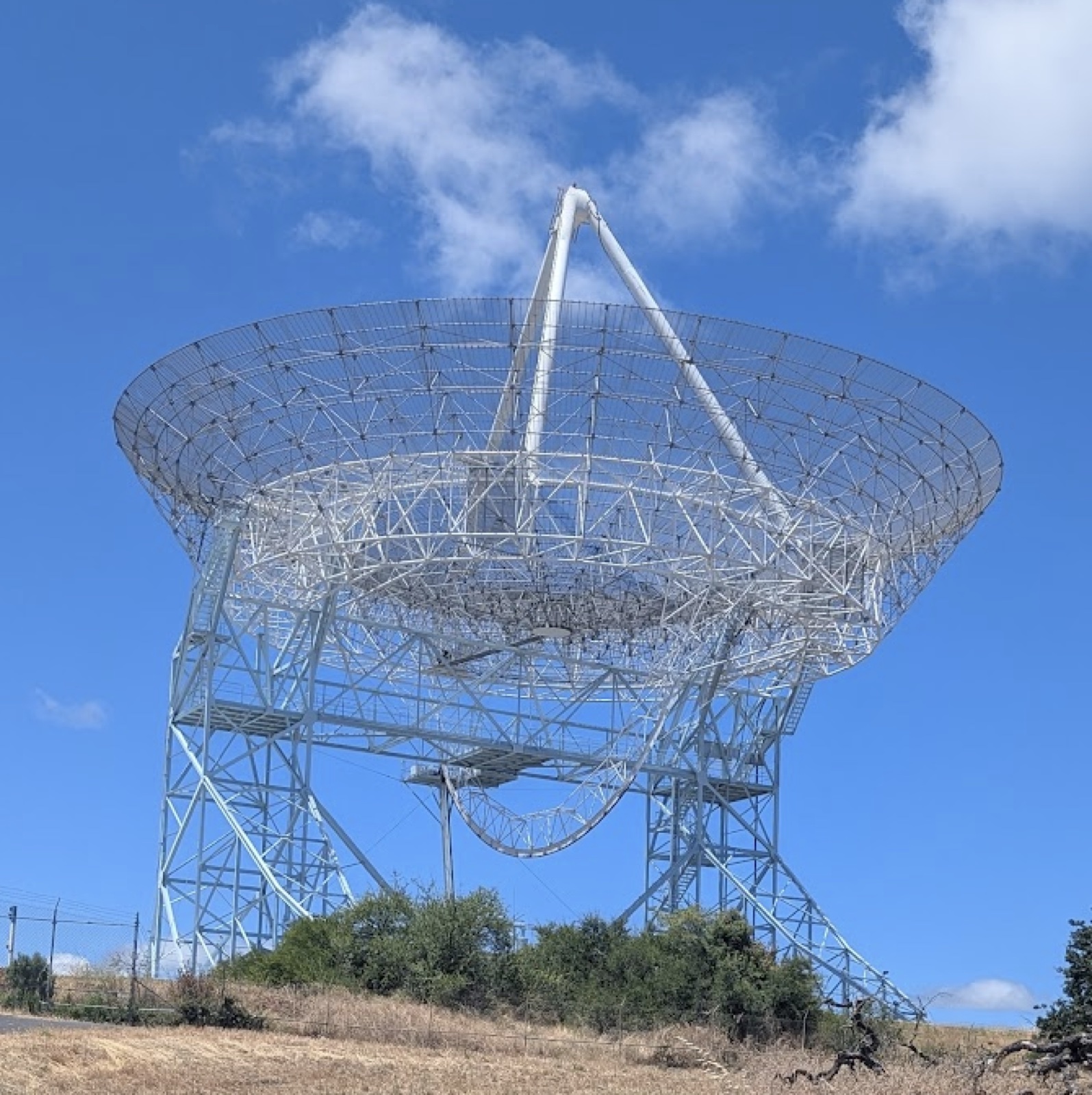
What do you see? I hiked to the Dish about three years ago and stood at this exact spot. Then, I had seen nothing but a large metal antenna. But we can see more: "It is a large, white metallic dish turned skyward. There are three metal rods standing inside it, forming a triangle which points upward. The dish is supported on a large platform. There are several places to walk, and several staircases leading up to the dish. There is a metal semicircle hanging from the underside of the platform - no idea what it is for. There is a tiny bird sitting on the very top of the triangle (hard to see in the image). The metal lines of the dish meet at its center in a thicket of polygons. The whole structure is fenced off. There is green foliage inside the fence."
Is the Dish less interesting than the paintings? Perhaps, perhaps not. Ask a radio engineer! But I think seeing it deeply increased my appreciation of it - I would hardly have noticed the bird otherwise. Imagine standing next to it and going through the words in your head. Wouldn't you feel more connected to reality?
I think verbalizing works on a similar basis as writing: by forcing you to clarify your thoughts and confront the contradictions therein. It forces you to slow down, go bit by bit (e.g., how many gas pumps?), forces you to interpret what you're seeing (e.g., is that a dolphin or a fox?). Once you've done this several times, you can't help but notice patterns between paintings, between groups of paintings (e.g., expressionism vs. impressionism), even between the same painter (e.g., early vs. late Monet). In other words, it helps you pay attention, and paying attention can make almost anything interesting. Why? Because the world is fractal in its detail; there is more to see anywhere you might look.
Here is one more Kandinsky I saw at the Guggenheim. This one is challenging.
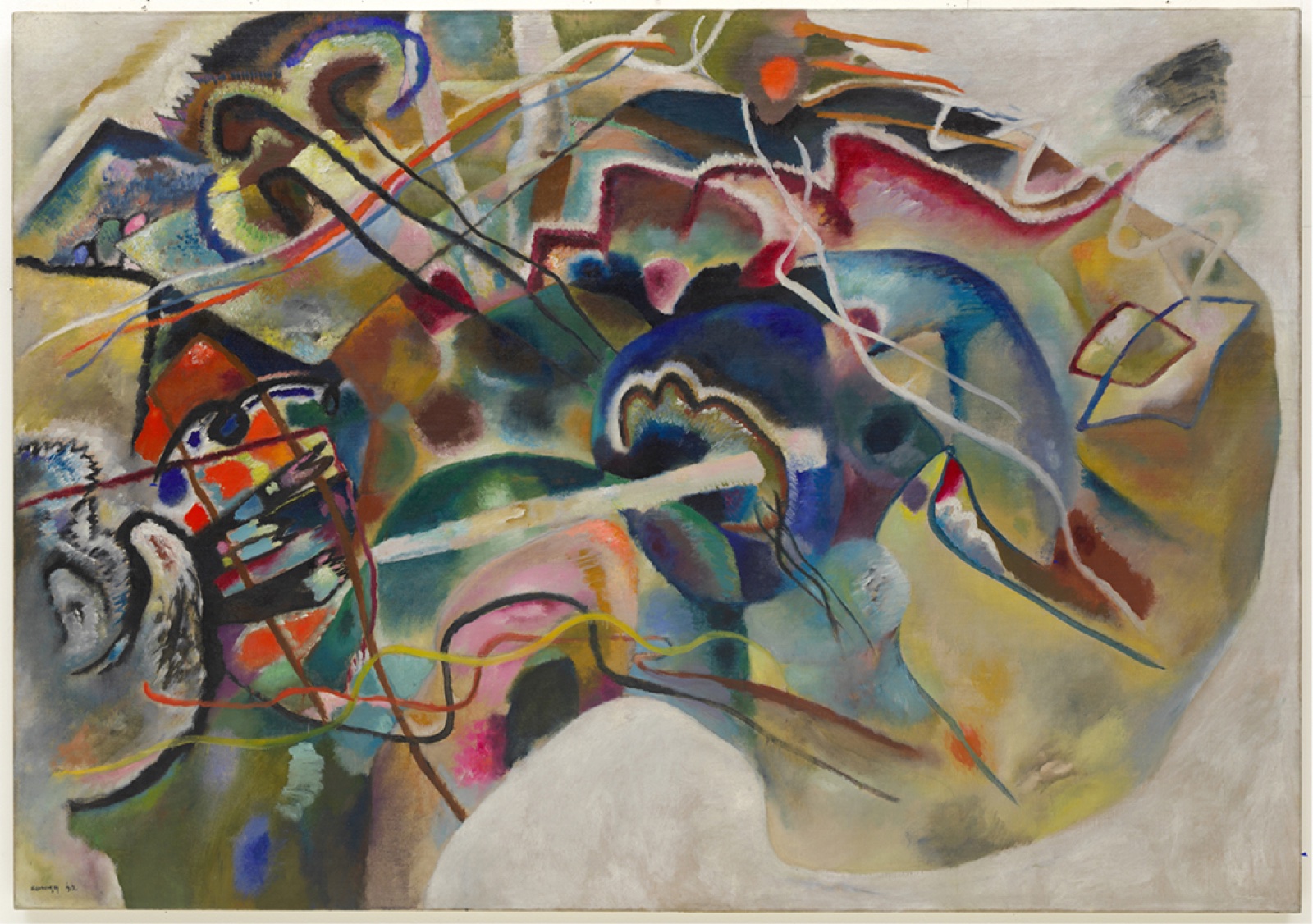
What do you see?